Feather Guard is a Leading Supplier of Sonic and Ultrasonic Bird Repellents and complete bird proofing solutions, serving industries and properties across Gujarat and India since 1972.
Search this question online and you will find two camps: sellers promising instant results and reviewers claiming the devices do nothing. Both are wrong, and the truth sits in the details — which frequencies the device emits, which birds you are dealing with, and where it is installed. This guide gives you the honest answer, so you invest in a Sonic Ultrasonic Bird Repellent for the right reasons and place it where it will actually perform.
Ultrasonic sound sits above the range of human hearing, roughly 20 kHz and higher. Here is the part most product pages skip: most birds hear best between about 1 and 4 kHz, and their sensitivity drops sharply above 10 kHz. Pigeons, crows, minas and sparrows do not hear pure ultrasonic frequencies the way a bat or a dog would.
This is why a device that emits only ultrasonic sound often disappoints in open outdoor areas. It is not a scam — it is simply operating at frequencies the target birds barely register.
Ultrasonic frequencies perform well in specific conditions:
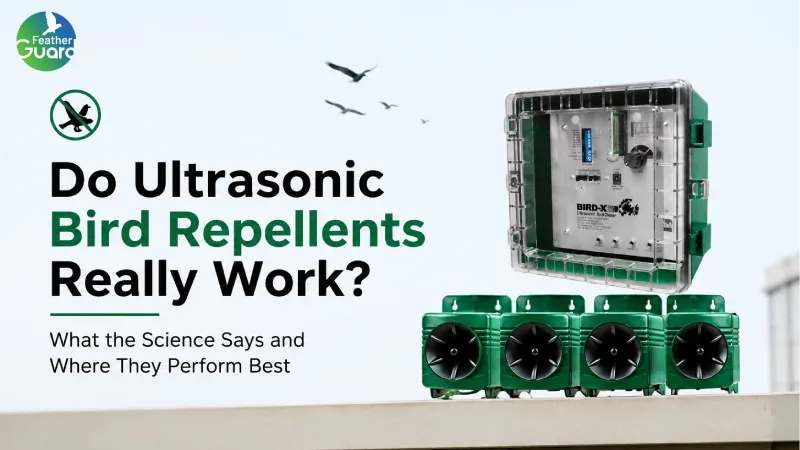
The four-speaker system we supply rates its ultrasonic coverage at up to 3,600 sq ft for exactly this reason: it is designed for structures, not open fields.
The science is clearer on sonic deterrents — audible sounds in the 3–5 kHz range that sit squarely within a bird's best hearing. When those sounds are digitally recorded predator calls and species-specific distress calls, birds respond instinctively: a pigeon hearing a hawk call or a flock-mate in distress reads the area as dangerous and leaves.
A combined Sonic Ultrasonic Bird Repellent works on two levels at once:
This is why field results from combination units are consistently stronger than ultrasonic-only devices.
The most legitimate criticism of any sound-based deterrent is habituation: birds learn that a repeated, predictable noise carries no real threat and start ignoring it. Well-designed Sonic Bird Repellent Products address this directly:
| Habituation Cause | Design Answer |
|---|---|
| Same sound, same interval | Programmable sound selection and randomised delay between calls |
| Runs at the wrong time | Built-in photocell activates at dawn, when birds are most active |
| Single fixed source | Four independent speakers, each on 100 ft of wire, placed at different points |
| Volume too low or too high | Adjustable output — 105–110 dB sonic per speaker at 1 metre |
Changing sound type and timing every few weeks keeps the threat unpredictable, which is what maintains long-term effectiveness.
From our experience across Gujarat's industrial belts, sonic-ultrasonic systems deliver the strongest results in:
Remote sites are not a barrier: the unit runs on a 12V deep-cycle battery or a small solar panel, inside a weather-resistant NEMA-type enclosure.
Ultrasonic alone, in an open field, aimed at pigeons — expect weak results. A programmable sonic-ultrasonic combination, correctly placed, rotated regularly, and used alongside physical measures like netting or spikes where birds are already nesting — expect a significant, sustained reduction in bird pressure. The device is a tool; the outcome depends on matching it to the site.
Feather Guard, has specialised in bird proofing since 1972, with ISO, HACCP and GMP certifications and offices in Ahmedabad, Surat, Vadodara and Gandhidham. We do not sell a device and leave; our trained technicians survey your site, assess bird pressure and species, and recommend the right combination of Sonic Bird Repellent Products, netting, spikes, laser deterrents or invisible grills. Every solution is humane, safe for people, and backed by a track record across food, pharma, warehousing, aviation and hospitality clients.
Ultrasonic bird repellents do work — within the conditions their physics allows. Pure ultrasonic sound has limited reach with most pest birds and performs best in enclosed structures. Sonic distress and predator calls operate inside a bird's core hearing range and deliver far stronger results outdoors. Combining both, with programmable timing, randomised sounds and multi-point speaker placement, addresses the habituation problem that undermines cheaper devices. The decision that matters is not whether to buy a repellent, but which type, where to place it and how to maintain unpredictability. Feather Guard brings decades of field experience to that decision, so the system you install actually performs.
Dealing with pigeons, crows or mynas at your warehouse, plant, farm or building? Request a free site assessment and we will recommend the right Sonic Ultrasonic Bird Repellent setup for your space. Call us: +91 8448444801 or Email: care@featherguard.co.in — and let Feather Guard solve the problem at its source.
CEO, Feather Guard (by Bitco Integrated Pest Management LLP), Ahmedabad
A results-driven leader, Mitesh Agarwal spearheads Feather Guard as one of Gujarat's most trusted bird-proofing and pest management companies. Under his leadership, the firm achieved IPCA, HACCP, and ISO certifications and won the prestigious Gujarat Icons 2024 Award by the Times of India Group. His digital transformation vision, including 100% ERP implementation, has driven exponential growth delivering humane, technology-backed bird control solutions across residential, commercial, and industrial sectors.
Yes, ultrasonic bird repellents can be effective but their performance depends on factors such as frequency, placement, and the type of birds. Pure ultrasonic sounds may have limited reach, while combining sonic deterrents with ultrasonic ones often yields better results.
Sonic bird repellent products emit audible sounds, typically in the 3–5 kHz range that birds can hear well, including distress and predator calls. Ultrasonic products emit sounds above human hearing, typically above 20 kHz, which may not be heard effectively by many birds unless in enclosed spaces.
For optimal performance, install a Sonic Ultrasonic Bird Repellent in enclosed or semi-enclosed spaces like warehouses or loading docks, as well as near roosting areas where birds spend extended periods. Proper placement is crucial to maximize the device's effectiveness.
To combat habituation, use programmable sonic bird repellent products that can randomize sound selection and intervals. Additionally, changing sound types and volume levels intermittently can maintain unpredictability and ensure long-term effectiveness.
Sonic and ultrasonic repellents can deter various bird species such as pigeons, crows, and sparrows. However, the effectiveness relies on proper frequency emissions, as different species have different hearing sensitivities.

Copyright © All Rights Reserved To Feather Guard By Bitco | Designed & Developed By Clients Now SEO Agency | Website Updated On : 03 September 2026